Book a tour
Skip the map and see the list

Vineyard, Ditchling, East Sussex

Hollowdene Vineyard

Seven hectares of Chardonnay, Pinot and Bacchus on a south-facing slope below Ditchling Beacon.

This map is the walk. Open it on your phone in the car park. The posts on the walk are numbered 1 to 8, the same as here.

Open Wednesday to Sunday, 11am to 5pm. November to March, Friday to Sunday, 11am to 4pm.

List view

Drag the map, or use the arrow keys, to move around. Plus and minus zoom in and out. Tab moves from place to place, and Enter opens one.

Show the vines in
At a post? Tap its number

List view

Every place on the map

The same places as the map, in the order of the walk, with what you will see there in each season. The car park comes first and the footpath to the Downs last.

Not on the walk

Car park

Free, 40 spaces, 2 accessible bays by the shop

Turn in off Hollowdene Lane at the white gate. The accessible bays are beside the shop door, and the shop, the tasting barn and the gravel path between them are step-free. There is a bike rack by the cottage wall; Hassocks station is about 4 km away.

Winter November to March
The gate is locked at 4:30pm from November to March.
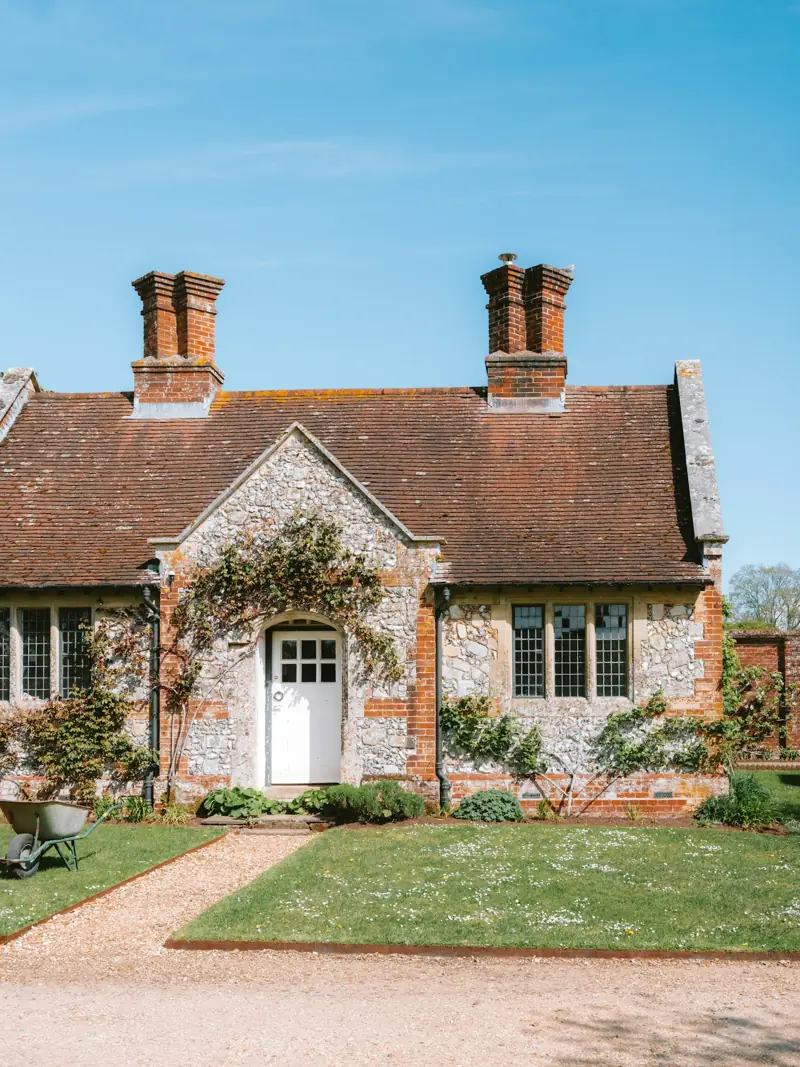
A flint and brick cottage with two tall chimneys and a white door

Stop 1 of 8

The shop

In the flint cottage by the car park. The walk starts here.

This was the farm cottage until 2009. Now it is where you pay for the walk and collect a glass, a pencil and a paper copy of this map, and where every Hollowdene wine is sold by the bottle or the case.

Spring April and May
The new rosé is bottled in March, so the shop has it first.
Summer June to August
Busiest on Saturday afternoons. Come before noon for a quieter walk.
Harvest September and October
Fresh grape juice from the press in September, in 1 litre bottles, while it lasts.
Winter November to March
Gift boxes and the Christmas case of six. Open Friday to Sunday.

Wednesday to Sunday, 11am to 5pm. November to March, Friday to Sunday, 11am to 4pm.

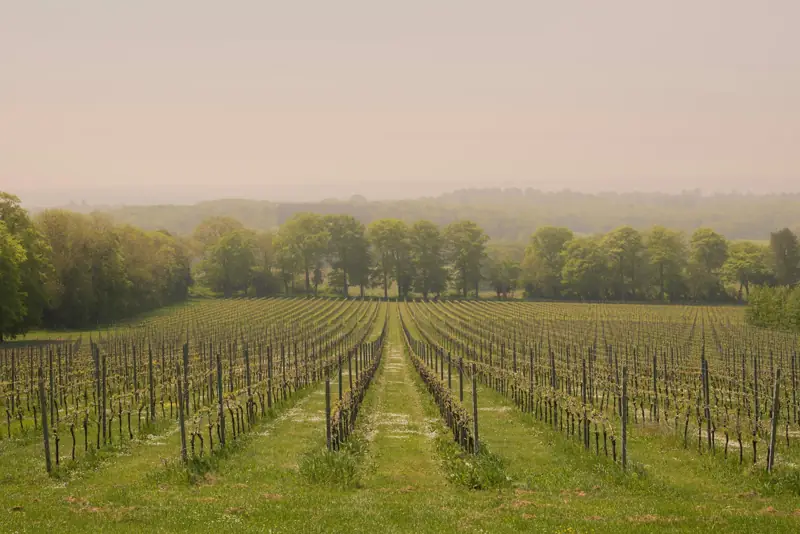
Rows of vines running away into morning haze, with trees beyond

Stop 2 of 8

Long Slope

Pinot Noir. 2 hectares, 8,100 vines, planted 2011

Our first block and the steepest, dropping 14 metres from the top headland to the bottom. Cold air drains down it on spring nights and away into the dene, so it rarely frosts. Most of it goes into the Classic Cuvée; in good years the top twelve rows make a still red.

Spring April and May
Budburst usually comes in the last week of April. Look for the bronze tips of the first leaves.
Summer June to August
In July we pull the leaves off the morning side of each row so the bunches get the sun.
Harvest September and October
Picked by hand in the second or third week of October. The leaves turn deep red after picking.
Winter November to March
Pruning starts in December. Each vine is cut back to one cane and tied along the wire.

Stop 3 of 8

Beacon View

Pinot Meunier. 1.6 hectares, 6,400 vines, planted 2016

Turn round at this post and Ditchling Beacon is on the skyline, 2.4 km to the south. Meunier buds a week later than the Pinot Noir next door, which helps in a year with a late frost. It gives the Classic Cuvée its soft, bready middle.

Spring April and May
If frost is forecast we light candles between the rows at 3am. The black pots wait along the headland.
Summer June to August
Flowering in late June. For about ten days the block smells faintly of honey.
Harvest September and October
Usually the last Pinot picked, early in the fourth week of October.
Winter November to March
Sheep from the next farm graze the grass between the rows from January to March.
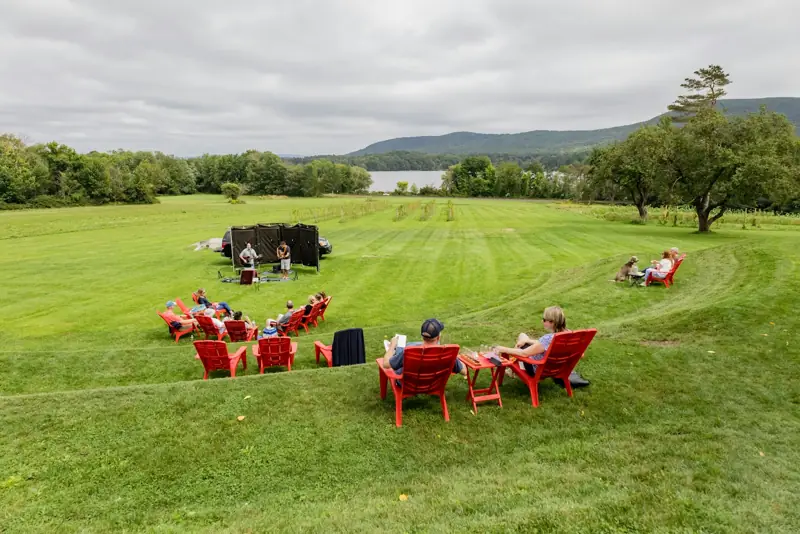
People on red chairs on a mown lawn, listening to a small band

Stop 4 of 8

The pond and the dene

The hollow that gives Hollowdene its name

A dene is a small valley. This one collects the cold air off the slopes and the rain off the whole estate, which is why the pond never dries. The bench under the old oak is the best place for a picnic; bring your own, or buy bread and cheese at the shop.

Spring April and May
Frogspawn in the shallow end in March, and the willows come into leaf.
Summer June to August
Music on the grass above the pond on Sunday afternoons in July and August, free with a walk ticket.
Harvest September and October
On still autumn mornings the mist sits in the dene until about ten.
Winter November to March
The south side gets muddy. Wear wellies, or keep to the gravel on the north side.
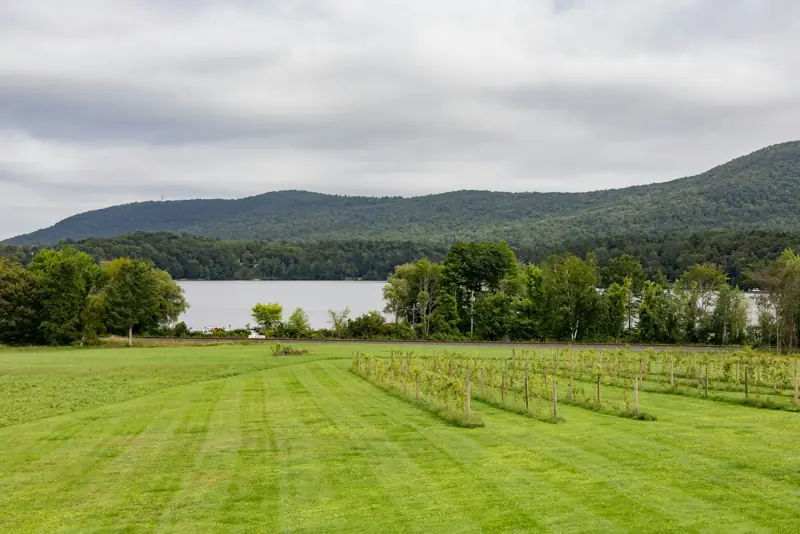
Young vines on mown grass sloping down towards water and wooded hills

Stop 5 of 8

Pond Field

Bacchus. 2.1 hectares, 8,400 vines, planted 2019

Our youngest vines, and the only ones not grown for sparkling wine. Bacchus is the grape England does best on its own: elderflower, cut grass and grapefruit. The low corner by the pond is the warmest spot on the farm by mid-afternoon.

Spring April and May
In May the new shoots grow up to 3 cm a day, and we tuck them into the wires by hand every week.
Summer June to August
Nets go on in August, because the blackbirds find the Bacchus first.
Harvest September and October
The first block we pick, usually late September. Ask in the shop to join a picking morning.
Winter November to March
The 2025 Bacchus is in the shop, £19 a bottle.

Stop 6 of 8

Top Bank

Chardonnay. 1.8 hectares, 7,200 vines, planted 2013

The highest block, at 74 metres, on greensand that warms up quickly in the morning. Chardonnay from here goes into the Blanc de Blancs, which rests at least four years in the cellar before we sell it. From the post you can see the whole estate and the Downs behind it.

Spring April and May
Chardonnay buds first, so this is the block we worry about on frosty April nights.
Summer June to August
Look for the tiny flowers in June. A warm, dry fortnight then makes a good year.
Harvest September and October
Picked after the Bacchus, in early October. The leaves turn gold rather than red.
Winter November to March
Pruning finishes here in March. The cut canes go on the brazier at the tasting barn.

Stop 7 of 8

The winery

Press, tanks and about 100,000 bottles in the cellar

Built into the bank in 2015, so the cellar stays at 12°C without air conditioning. The grapes come in at the top, the press sits in the middle, and the sparkling wine rests in the cellar below for three to five years. Walkers stay outside, but the long window shows the press and the riddling cages.

Spring April and May
Disgorging and corking in March, when the 2021 wine becomes the Classic Cuvée.
Summer June to August
Quiet. Last year's still wines are bottled in June.
Harvest September and October
The press runs day and night for about three weeks. You can smell it from the car park.
Winter November to March
Blending. We taste every tank in January and decide which wine each one becomes.

Inside only on the guided tour, Saturday and Sunday at 11am and 2pm.
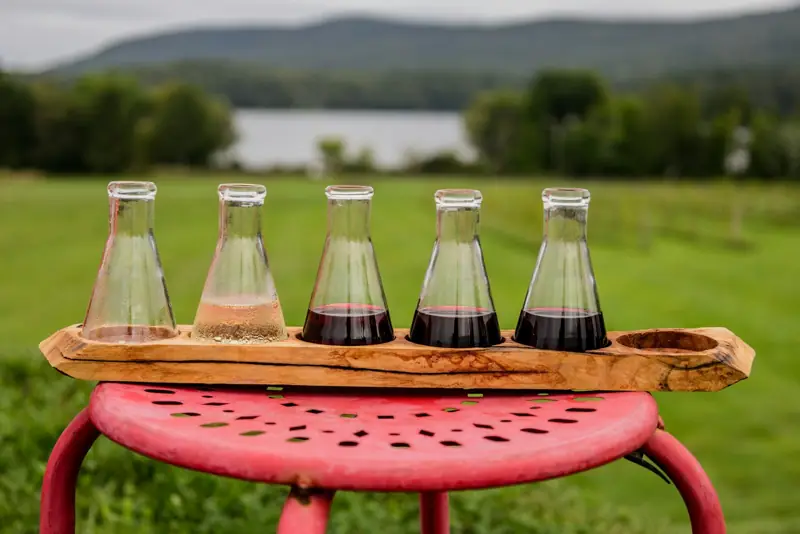
Five small glass carafes of wine on a wooden board on a red stool

Stop 8 of 8

The tasting barn

The end of the walk. Three tastes are waiting.

A black weatherboarded barn from the 1850s with a terrace facing south over the vines. Hand in your walk card and we pour three tastes from whatever is open that day. Drivers get theirs in three small sealed bottles to take home.

Spring April and May
The terrace opens at Easter.
Summer June to August
Glasses of wine and plates of Sussex cheese on the terrace until 5pm.
Harvest September and October
Grape juice straight from the press for children and drivers.
Winter November to March
The wood burner is lit, with hot apple juice for walkers.

Last walk starts at 3:30pm, or 2:30pm from November to March.

Not on the walk

Footpath to the Downs

Public footpath, 2.4 km up to Ditchling Beacon

From the gate on the south side of the pond, a public footpath crosses two fields and climbs the chalk to Ditchling Beacon, 248 metres up, and the South Downs Way. Allow 50 minutes up and 35 back down. It is open all year, whether we are or not.

Spring April and May
Cowslips on the chalk bank in April.
Summer June to August
No shade on the climb, so take water.
Harvest September and October
The fields above us are often ploughed. Keep to the edge.
Winter November to March
The chalk is slippery after rain.

On the day

How the walk works

  1. 1

    Park and pay at the shop

    £18 a person, under 18s free with an adult. You get a glass, a paper map and a walk card.

  2. 2

    Open this page on your phone

    There is signal across the estate. The posts carry the same numbers as the map, so tap a number when you reach its post.

  3. 3

    Walk at your own pace

    1.4 km and about an hour with stops, on grass and gravel, with one steep stretch on Beacon View. Dogs on leads are welcome.

  4. 4

    Three tastes at the end

    Hand in your card at the tasting barn. The last walk starts at 3:30pm, or 2:30pm from November to March.

From the visitors book

What walkers say

We followed the map on my phone and the children raced each other to every post. A case of the Bacchus came home with us.
Hannah, Burgess Hill
Went in February expecting nothing to see. The pruning was interesting and the stove was lit in the barn.
Pete, Hassocks
My husband drove, so his three tastes came home in little bottles. Such a good idea.
Sue, Lewes

Before you come

Questions we get asked

Do I need to book the walk?

No. Turn up any time we are open and pay at the shop. Guided tours and the winemaker's lunch do need booking.

What if I do not have a smartphone?

Everyone gets the same map on paper, with the posts numbered the same way.

Can I bring the dog?

Yes, on a lead, on the walk, on the terrace and in the shop. Not in the winery.

Is the walk step-free?

The shop, the tasting barn, the gravel path between them and the north side of the pond are. The rest is grass with one steep stretch. On weekdays we can drive you round the lower half if you ring ahead.

Can children come?

Yes. Under 18s walk free with an adult and get grape juice at the end. Tastings are for over 18s only.

Guided tours on Saturdays and Sundays

90 minutes with the winemaker, inside the winery and the cellar, with five wines at the end. £32 a person, up to 14 on each tour.